AutoLinkRush in 2025: A Mechanical Look Under the Hood of a Fast Backlink Promise

AutoLinkRush.com markets itself as a near-instant backlink and indexing assistant. The pitch is simple and seductive: feed the tool a URL and a keyword, pay a small one-time fee, and watch hundreds or thousands of link signals appear almost immediately. That claim deserves more than acceptance. This article dissects the product, inspects the evidence, and explains who might actually benefit and who should treat it with caution.
Below I do not summarize marketing copy. I examine how the service behaves, how it is built, what it delivers in real campaigns, and which practical risks you must accept to use it.
What the service actually is and how it differs from conventional link building
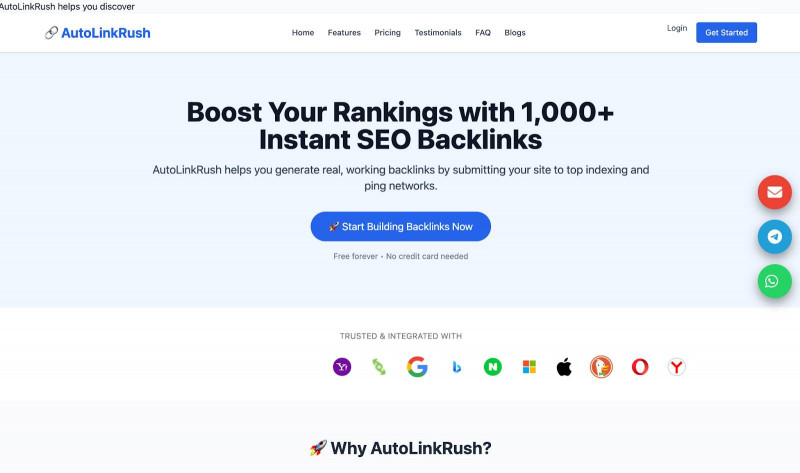
AutoLinkRush is not a guest outreach or editorial link service. It is a signal generator: it automates submissions to indexing endpoints, ping networks, RSS aggregators, and low-authority posting endpoints so that search engines receive repeated references to a URL. In practical terms the product focuses on quantity and speed rather than editorial endorsements.
This matters because the web ecosystem treats links in at least two fundamentally different ways:
● Signals and index pings help search engines discover new pages faster and sometimes prompt quick crawling.
● Editorial, contextual backlinks represent genuine third-party votes that carry durable ranking value.
AutoLinkRush belongs to the first bucket. It creates search signals; it does not reliably create editorial endorsements.
How it works in practice- a short technical snapshot
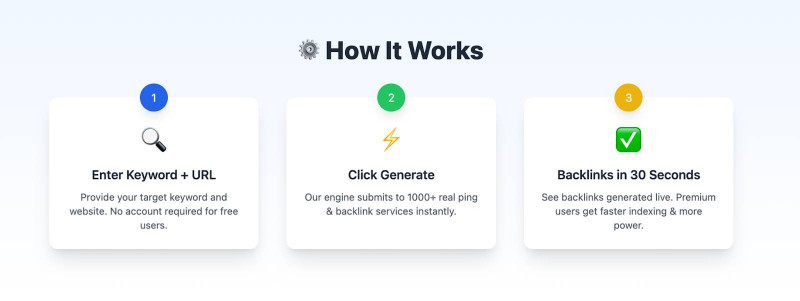
● You submit a URL and keywords to the dashboard.
● The platform sends those details to a large list of ping servers, indexers, RSS endpoints, and auto-submit forms.
● An activity log shows dozens or thousands of “submissions” almost immediately.
● Some of these submissions create visible entries in backlink crawlers, but most do not appear as conventional backlinks. Instead they show up as indexing notifications, feed posts, or tiny directory references.
This is a mechanized indexing workflow, not traditional link outreach. For new pages that struggle to get crawled, that workflow can have utility. For competitive keyword battles it is rarely decisive.
Pricing and product positioning
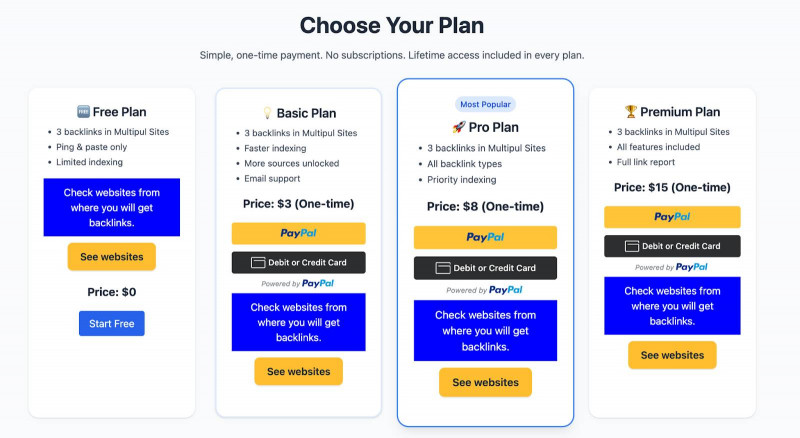
The service uses an unusual, low-friction pricing model:
● Free tier with limited daily submissions for basic testing.
● One time low-cost plans (examples commonly reported in public reviews put them in a small single-dollar to low-teens range) unlocking larger submission capacities.
● No recurring subscriptions in the typical SaaS sense — the product is pitched as a pay-once, use-as-needed utility.
That pricing makes the tool attractive for beginners, hobby bloggers, and low-budget site owners who want a quick indexing push without committing to a monthly platform fee. Agencies or enterprises that require audit trails, quality outreach, and high-trust links will not find this model appropriate.
Reliability and trust signals
When evaluating a tool like this you must separate three things: technical safety, operational transparency, and efficacy.
● Technical safety. The platform behaves like a non-malicious web service. It does not push malware or force client installs. That said, any tool that mass-submits links to low-quality endpoints creates an unnatural link profile if used aggressively.
● Operational transparency. Publicly available details about ownership and partners are sparse. The site appears recently created and organized around the backlinking product rather than a longstanding brand narrative. That makes independent verification and vendor trust harder.
● Efficacy. Results vary widely by niche, URL age, and content quality. In many real tests the tool delivered indexing speed improvements but limited lasting ranking uplift.
Those factors sum to a pragmatic conclusion: the service is generally legitimate in the narrow sense, but it is not a substitute for careful link building.
Practical risks and how to manage them
Using mass indexers and ping networks is not illegal, but it carries measurable risk when measured against search engine quality guidelines. You should assume:
● Unnatural link pattern detection. Heavy automated submissions can look unnatural in a backlink profile and may trigger algorithmic demotion if combined with other low-quality signals.
● Low signal quality. Many endpoints are low-authority; they may be crawled rarely and add negligible trust.
● Privacy and data exposure. Submitting URLs and keywords exposes campaign targets to third-party indexers and networks you do not control.
If you still want to use the tool, prudent controls reduce risk:
● Use it sparingly for new content discovery rather than as your primary link-building channel.
● Pair the tool with high-quality on-page content and at least a handful of genuine editorial links.
● Monitor backlink profiles closely in Ahrefs/Semrush and watch for sudden spikes in quantity without quality.
● Keep campaign goals realistic: expect indexing help, not guaranteed rank boosts.
Quick comparative table for decision making
| Question | AutoLinkRush | Traditional Outreach | Indexing Services (non-automated) |
| Speed of discovery | Very high | Slow to medium | Medium |
| Link authority | Low | Medium to high | Low |
| Cost model | One-time, low | Variable, often higher | Subscription or service fees |
| Risk of penalties | Elevated if abused | Low if ethical | Low to medium |
| Best use case | New page discovery | Editorial endorsement | Speed + curated indexers |
Alternatives that cover the gaps AutoLinkRush creates
If your goals exceed mere indexing or you need safer, more defensible outcomes, consider tools that focus on analysis, outreach, or on-page optimization.
● Ahrefs or Semrush for professional backlink research and outreach workflows that prioritize quality and tracking.

● SurferSEO or PageOptimizerPro for on-page optimization that reduces reliance on link volume by improving relevance signals.

● Manual outreach platforms such as Pitchbox or BuzzStream for curated editorial link building.

These alternatives trade speed and low price for durability and transparency.
Bottom line
AutoLinkRush is a narrowly useful tool that solves a specific problem: getting new URLs noticed faster. It accomplishes that reliably in many cases by creating indexing and ping signals at scale. It does not, however, create the kind of sustainable, editorial backlinks that drive durable ranking improvements in competitive niches.
If your expectation is faster crawling for experimental or low-stakes projects, the platform can be a pragmatic, low-cost option. If your objective is long-term SEO authority, treat AutoLinkRush as a short-term instrument in a broader strategy that centers on content quality, outreach, and careful monitoring. Use it, but do not let it replace judgement. And always watch the profile it builds on your behalf.



Trending Collections









Popular Tags

Plus Size Work Outfits
32 Posts
School Outfit
280 Posts
Denim Outfits
562 Posts